
EV Charger Installation in Tampa, FL
Connect with licensed independent electrical contractors serving Tampa. Professional Level 2 charging, Tesla Wall Connectors, panel upgrades, and City of Tampa and Hillsborough County permits — from South Tampa and Hyde Park to Westchase and New Tampa.
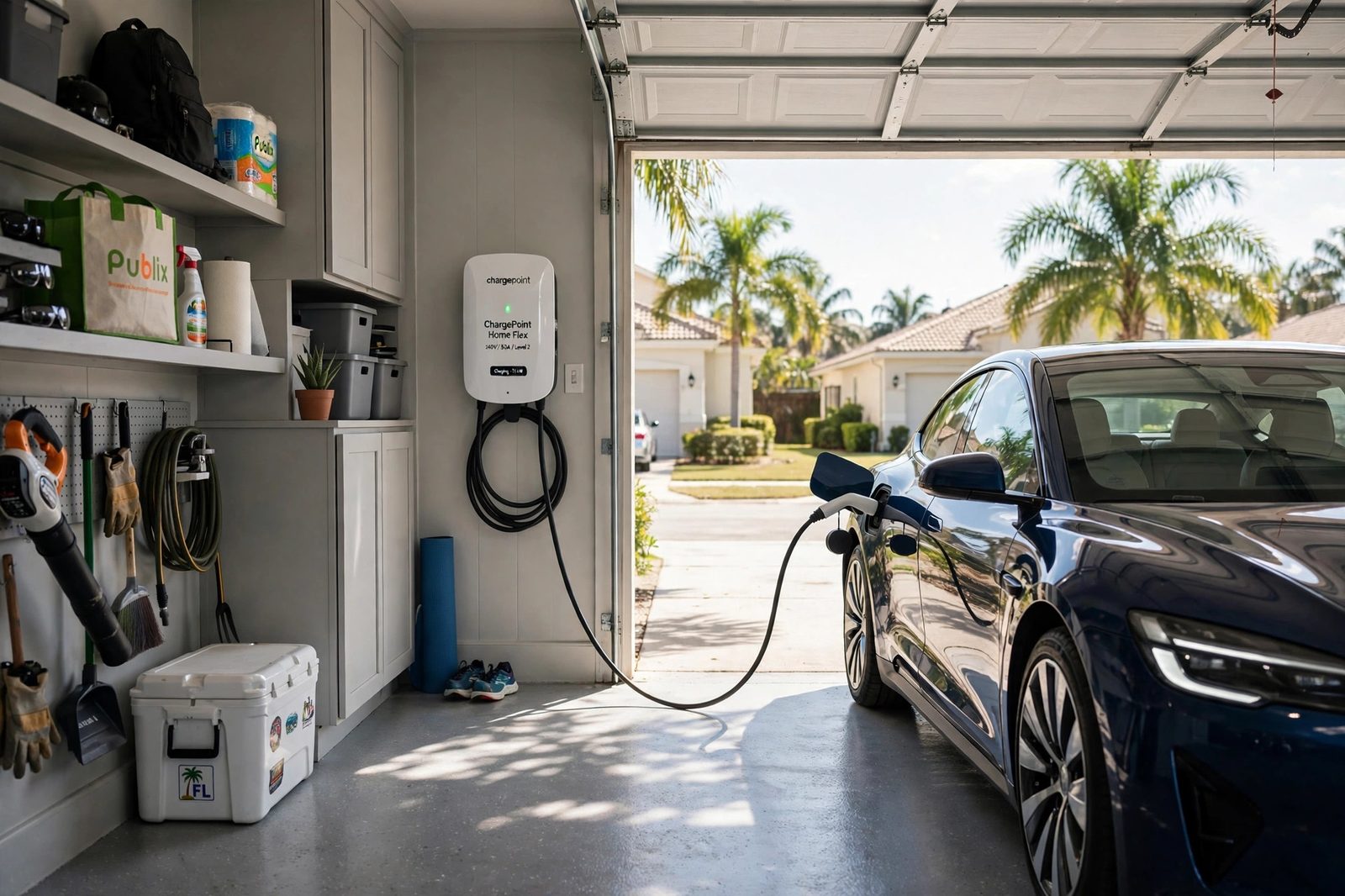
Residential EV Charger Installation Across Tampa
Homeowners throughout Tampa trust Florida Home Charger to connect with licensed, insured independent electrical contractors specializing in residential electric vehicle supply equipment (EVSE). Tampa is the largest new market in this wave: the brick streets and 1920s bungalows of Hyde Park and Seminole Heights, the canal-front homes of Davis Islands, the high-rise condos of Channelside and the Channel District, and the master-planned subdivisions of Westchase, Carrollwood, and New Tampa. That range is exactly why a one-size quote fails here: a 1925 Hyde Park bungalow and a 2015 Westchase garage are different electrical jobs wearing the same city name.
Tampa anchors the west coast of the state, with commuters crossing the Howard Frankland and Gandy bridges to St. Petersburg and running the Veterans Expressway and I-275 daily. Whether your home runs a 100-amp panel in an older Seminole Heights bungalow, a 200-amp service in Westchase, or a condo panel in a Channelside tower, independent professionals design the charging circuit around your actual service capacity and pull the required City of Tampa or Hillsborough County electrical permit for Tesla, Rivian, Ford, Hyundai, and every other modern EV. A standard installation with the panel nearby typically runs $750 to $1,500, while complex projects involving panel work or long runs can total $2,200 to $4,800 or more.
Why Tampa EV Charging Demands Bay-City Planning
Tampa's housing stock splits three ways, and each split changes the install. Hyde Park, Seminole Heights, and Ybor City hold pre-war and mid-century homes on 100- and 150-amp services, sometimes with panels that have not been touched in decades. South Tampa and Davis Islands add coastal exposure: salt air, storm surge history, and flood-zone mounting rules for ground-level garages. Westchase, Carrollwood, and New Tampa hold the opposite profile — modern 200-amp services, but strict HOA architectural review and long internal garage runs from panel to parking bay.
Condos add a fourth wrinkle. Channelside and Downtown towers often route parking through shared garages with association-controlled electrical rooms, which means the charger conversation involves the building engineer and the association board as well as the electrician. Florida Statute § 720.3075 bars HOAs from completely banning charger installations on a lot, but shared-garage buildings still require association approval for the parking-space and metering arrangement, and that approval can take longer than the permit itself.
Independent electricians serving Tampa therefore start every quote with three checks: panel age and capacity under an Article 220 load calculation, flood-zone and coastal mounting requirements where they apply, and HOA or condo approval rules. Getting those three right is the difference between a charger that passes inspection the first time and one that has to be moved or re-quoted.
4 EV Charging Solutions Tampa Homeowners Compare
Depending on your neighborhood, panel condition, and utility service, independent contractors evaluate four primary installation solutions:
1. Dedicated 48A Hardwired Level 2 Station
A dedicated 60-amp 240V circuit powers this hardwired station at the residential maximum of 11.5 kW, returning up to about 40 miles of range per hour — the right match for Tampa commuters crossing the bay bridges daily. Level 2 charging in general restores 25 to 40 miles per hour, versus 3 to 5 miles per hour on a standard Level 1 household outlet.
- Recommended for: Tesla Model S/X/Y, Rivian R1T/R1S, Hyundai Ioniq 5, Ford F-150 Lightning.
- Key advantage: No GFCI receptacle nuisance tripping and a sealed connection that tolerates bay humidity and salt air.
2. Heavy-Duty NEMA 14-50 240V Outlet
Installed on a 50-amp branch circuit, a heavy-duty NEMA 14-50 receptacle provides up to 9.6 kW (40 amps continuous) using your vehicle's mobile cable. It suits Tampa households that want a lower-cost first charger or a portable cable for a second vehicle.
- Hardware spec: A commercial-grade Hubbell or Bryant receptacle, built to carry continuous load without heat fatigue.
- Code note: NEC Article 625.54 requires GFCI protection at the breaker for receptacle charging circuits — a 50A GFCI breaker is part of the install.
3. Panel Upgrade on Older Tampa Homes
Many pre-war and mid-century homes in Hyde Park, Seminole Heights, and Ybor City still operate on 100-amp services, some with panels that predate modern breaker standards. Contractors replace fatigued panels, upgrade service to 200 amps, and add whole-home surge protection in the same permitted project as the EV circuit.
- Solution: 200A main service upgrade, or a NEC-compliant load management device where a full heavy-up is impractical.
- Protection: Type 2 surge protective devices are strongly recommended in one of America's most lightning-active regions.
4. Tesla Wall Connector & Universal Wall Connector
With Tesla among the most common EV badges in Hillsborough County, the Wall Connector's clean hardwired install and power-sharing between two units make it the default recommendation for two-EV garages in Westchase, Carrollwood, and New Tampa.
- Recommended for: Tesla households and mixed garages using the Universal Wall Connector's built-in J1772/NACS adapter.
- Key advantage: Power sharing lets two vehicles charge overnight on one 60-amp circuit.
What to Verify Before Scheduling Your Tampa Consultation
When you call Florida Home Charger at (407) 557-9563 from Tampa, tell us whether your home is a pre-war bungalow, a coastal property, or a condo — each one changes the approval path. These details complete the picture:
- Main Breaker Amperage: Locate your electrical panel and verify the main disconnect rating (typically 100A, 150A, or 200A), and note the panel brand and age.
- Flood Zone & Coastal Exposure: Note whether your home sits in a Tampa Bay flood zone or on Davis Islands, which sets charger mounting height and enclosure ratings.
- Parking Location: Identify where your EV will charge — attached garage, shared condo garage, carport, or open exterior driveway.
- Conduit Distance: Pace off the run from your breaker panel to the charger's wall — every extra ten feet is copper and labor.
- HOA or Condo Rules: In Westchase, Carrollwood, and Channelside towers, check association rules for conduit, equipment placement, and shared-garage metering.
Permit & Utility Coordination in Tampa
Electrical installations within Tampa city limits are governed by the City of Tampa Construction Services division, while homes in unincorporated Hillsborough County are permitted through Hillsborough County Development Services. That permit obligation covers every dedicated 240V circuit, subpanel, and fixed charger: a licensed independent contractor pulls it, and the jurisdiction inspects the finished work to the Florida Building Code and NEC Article 625. Under Article 625, continuous loads must be engineered at 125 percent of the charger's draw, which is why a 48-amp hardwired station lands on a 60-amp circuit.
Residential electricity in Tampa is delivered by Tampa Electric, known as TECO. When a property requires a 200-amp main service upgrade or meter base modernization, the electrical contractor coordinates with TECO for temporary disconnection and meter reconnect.
Tampa owners on TECO service have a utility program worth checking before they buy hardware. TECO's Prime Time Plus program gives monthly bill credits when you enroll a hardwired Level 2 charger, rewarding off-peak charging behavior rather than paying for the equipment itself — your contractor confirms current enrollment terms for your address. Note that the former federal 30C credit ended for equipment placed in service after June 30, 2026, so utility programs are now the main rebate path to check. Current statewide incentive options are tracked on our Florida EV charger incentives page, and statewide permit steps are covered in our Florida EV charger permits guide.
Nearby Tampa Bay Service Areas
Florida Home Charger connects homeowners with trusted independent electrical contractors across the Tampa Bay corridor. Directly north, explore our hub in Wesley Chapel; across the bay, our St. Petersburg hub serves Pinellas County, while Sarasota and Lakewood Ranch cover the Gulf Coast south. Tampa owners can sanity-check any quote against our Florida EV charger installation cost guide, which itemizes the pricing variables. Tampa matches start through our Florida home charging referral service.
Frequently Asked Questions: Tampa EV Charging
Is an electrical permit required for an EV charger in Tampa?
What is TECO Prime Time Plus?
Can a 100-amp panel in a Hyde Park bungalow handle a Level 2 charger?
How do flood zones affect charger placement in Tampa?
Who provides residential electric power in Tampa?
Ready to Install Your EV Charger in Tampa?
Speak directly with independent licensed electricians serving Tampa and surrounding communities today. Learn more about how our referral network works.
Call (407) 557-9563