
EV Charger Installation in Orlando, FL
Connect with licensed independent electrical contractors serving Orlando. Professional Level 2 charging, Tesla Wall Connectors, panel upgrades, and City of Orlando and Orange County permits — from College Park bungalows to Baldwin Park and Dr. Phillips family garages.
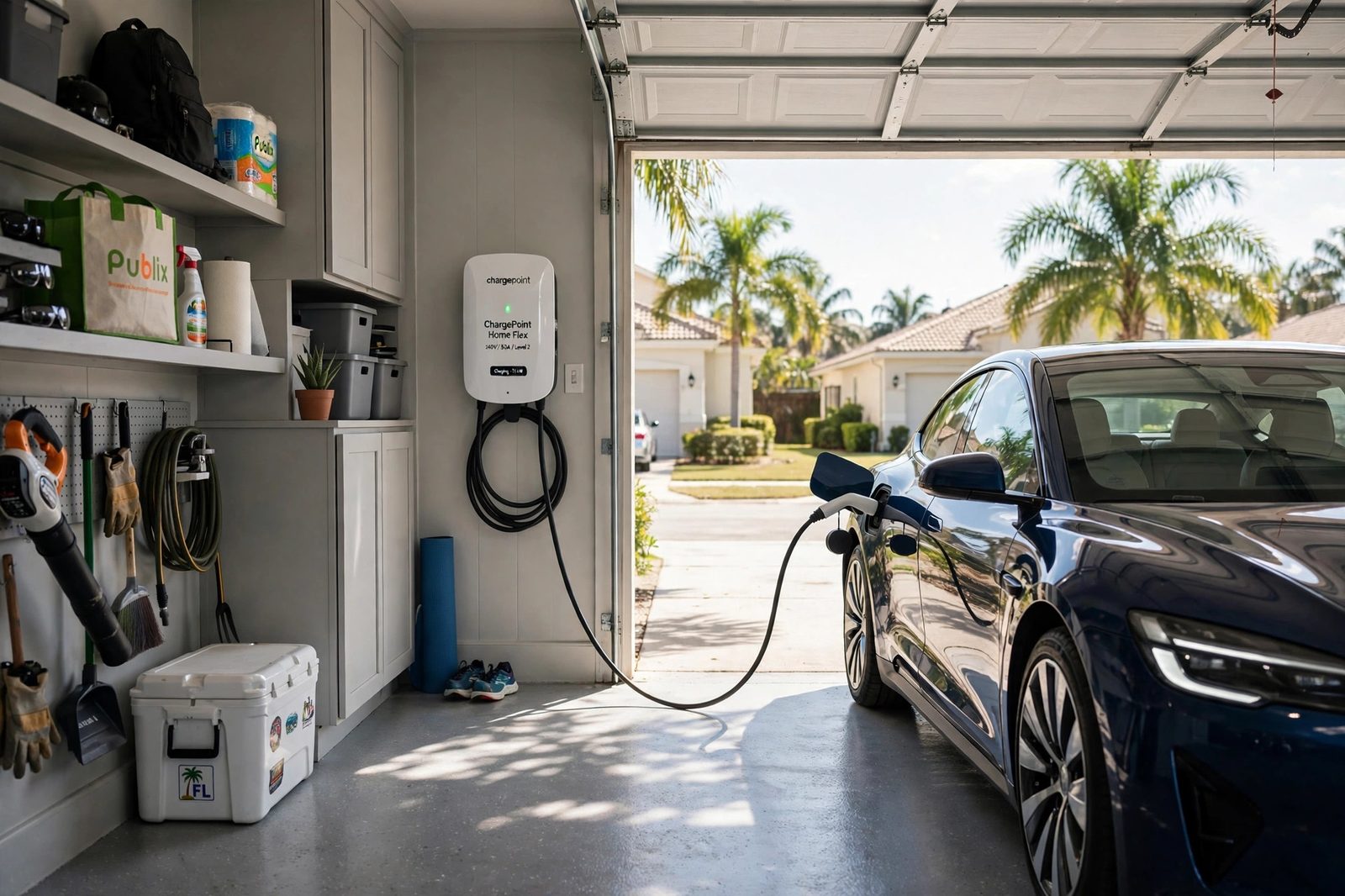
Residential EV Charger Installation Across Orlando
Homeowners across Orlando trust Florida Home Charger to connect with licensed, insured independent electrical contractors specializing in residential electric vehicle supply equipment (EVSE). The City Beautiful runs from the brick streets of Downtown and Thornton Park through the bungalow blocks of College Park, the planned streets of Baldwin Park, and the lakefront subdivisions of Conway and Dr. Phillips out to the apartment-and-townhome corridors of MetroWest. That spread is exactly why a one-size quote fails here: a 1940s College Park cottage and a 2015 Baldwin Park garage are different electrical jobs wearing the same city name.
Orlando is the hub our Central Florida network was built around: Winter Park sits to the north, Windermere and Lake Nona to the south, and Oviedo to the northeast, all feeding commuters onto I-4, the 408, and the 417 every morning. Whether your home runs a 100-amp panel in an older Thornton Park bungalow or a modern 200-amp service in Dr. Phillips, independent professionals design the charging circuit around your actual service capacity and pull the required City of Orlando or Orange County electrical permit for Tesla, Rivian, Ford, Hyundai, and every other modern EV. A standard installation with the panel nearby typically runs $750 to $1,500, while complex projects involving panel work or long runs can total $2,200 to $4,800 or more.
Why Orlando EV Charging Demands Utility-Aware Planning
Orlando is one of the few Florida cities where the first question is not just panel size but which utility serves the meter. The Orlando Utilities Commission (OUC) covers the city core, while Duke Energy Florida serves surrounding pockets and much of the metro fringe, and the boundary between them can change from one subdivision to the next. That matters because rate options and rebate programs follow the provider, not the city name — a contractor who assumes the wrong utility can quote the wrong program. Independent electricians serving Orlando therefore confirm the serving utility from the meter before they finalize any quote.
Housing stock adds the second layer. College Park and Thornton Park bungalows often carry 100-amp services, sometimes with panels that have not been touched in decades, while Baldwin Park, MetroWest, and Dr. Phillips homes usually have 200-amp services with spare breaker space. Townhomes and condos near Downtown add a third wrinkle: shared walls, HOA architectural review, and garage panels that may sit far from the assigned parking bay. Florida Statute § 720.3075 bars HOAs from completely banning charger installations on a lot, but exterior conduit routing and equipment placement still go through architectural review in most planned communities.
Independent electricians serving Orlando therefore start every quote with three checks: serving utility, panel capacity under an Article 220 load calculation, and HOA or condo placement rules. Getting those three right is the difference between a charger that passes inspection the first time and one that has to be moved or re-quoted.
4 EV Charging Solutions Orlando Homeowners Compare
Depending on your neighborhood, panel condition, and utility service, independent contractors evaluate four primary installation solutions:
1. Dedicated 48A Hardwired Level 2 Station
A dedicated 60-amp 240V circuit powers this hardwired station at the residential maximum of 11.5 kW, returning up to about 40 miles of range per hour — ideal for Orlando commuters crossing town on I-4 daily. Level 2 charging in general restores 25 to 40 miles per hour, versus 3 to 5 miles per hour on a standard Level 1 household outlet.
- Recommended for: Tesla Model S/X/Y, Rivian R1T/R1S, Hyundai Ioniq 5, Ford F-150 Lightning.
- Key advantage: No GFCI receptacle nuisance tripping and a sealed connection that tolerates hot, humid garage conditions.
2. Heavy-Duty NEMA 14-50 240V Outlet
Installed on a 50-amp branch circuit, a heavy-duty NEMA 14-50 receptacle provides up to 9.6 kW (40 amps continuous) using your vehicle's mobile cable. It suits Orlando households that want a lower-cost first step or a portable cable they can take when they move.
- Hardware spec: A commercial-grade Hubbell or Bryant receptacle, built to carry continuous load without heat fatigue.
- Code note: NEC Article 625.54 requires GFCI protection at the breaker for receptacle charging circuits — a 50A GFCI breaker is part of the install.
3. Panel Upgrade on Older Orlando Homes
Many pre-war and mid-century homes in College Park, Thornton Park, and Conway still operate on 100-amp services, some with panels that predate modern breaker standards. Contractors replace fatigued panels, upgrade service to 200 amps, and add whole-home surge protection in the same permitted project as the EV circuit.
- Solution: 200A main service upgrade, or a NEC-compliant load management device where a full heavy-up is impractical.
- Protection: Type 2 surge protective devices are strongly recommended in one of America's most lightning-active regions.
4. Tesla Wall Connector & Universal Wall Connector
With Tesla among the most common EV badges in Orange County, the Wall Connector's clean hardwired install and power-sharing between two units make it the default recommendation for two-EV garages in Baldwin Park, Dr. Phillips, and MetroWest.
- Recommended for: Tesla households and mixed garages using the Universal Wall Connector's built-in J1772/NACS adapter.
- Key advantage: Power sharing lets two vehicles charge overnight on one 60-amp circuit.
What to Verify Before Scheduling Your Orlando Consultation
When you call Florida Home Charger at (407) 557-9563 from Orlando, tell us whether your home is on OUC or Duke Energy service — it changes which rate and program options your contractor checks. These details complete the picture:
- Main Breaker Amperage: Locate your electrical panel and verify the main disconnect rating (typically 100A, 150A, or 200A), and note the panel brand and age.
- Serving Utility: Check whether your meter reads OUC or Duke Energy Florida, or send a photo of the meter — program eligibility follows the provider.
- Parking Location: Identify where your EV will charge — attached garage, detached garage, carport, or open exterior driveway.
- Conduit Distance: Pace off the run from your breaker panel to the charger's wall — every extra ten feet is copper and labor.
- HOA or Condo Rules: In Baldwin Park, MetroWest, and Downtown condo buildings, check architectural review rules for exterior conduit and equipment placement.
Permit & Utility Coordination in Orlando
Electrical installations within Orlando city limits are governed by the City of Orlando Permitting Services division, while homes in unincorporated Orange County are permitted through Orange County Building Safety. That permit obligation covers every dedicated 240V circuit, subpanel, and fixed charger: a licensed independent contractor pulls it, and the jurisdiction inspects the finished work to the Florida Building Code and NEC Article 625. Under Article 625, continuous loads must be engineered at 125 percent of the charger's draw, which is why a 48-amp hardwired station lands on a 60-amp circuit.
Residential electricity in the Orlando city core is delivered by the Orlando Utilities Commission (OUC), while Duke Energy Florida serves surrounding pockets of the metro area. When a property requires a 200-amp main service upgrade or meter base modernization, the electrical contractor coordinates with the serving utility for temporary disconnection and meter reconnect.
OUC customers should note one distinction carefully: OUC offers a $200 rebate when you purchase or lease an eligible electric vehicle, with applications due within 6 months — that is a vehicle rebate, not an installation rebate, and it does not pay for the charger circuit itself. OUC also offers a residential time-of-use rate with cheaper off-peak hours, which pairs well with overnight Level 2 charging. Note that the former federal 30C credit ended for equipment placed in service after June 30, 2026, so utility programs are now the main rebate path to check. Current statewide incentive options are tracked on our Florida EV charger incentives page, and statewide permit steps are covered in our Florida EV charger permits guide.
Nearby Central Florida Service Areas
Florida Home Charger connects homeowners with trusted independent electrical contractors across the Central Florida corridor. Directly north, explore our hub in Winter Park; to the southwest, our Windermere hub serves the lakefront estates, while Lake Nona covers the medical-city growth corridor and Oviedo serves Seminole County commuters. Orlando owners can sanity-check any quote against our Florida EV charger installation cost guide, which itemizes the pricing variables. Orlando matches start through our Florida home charging referral service.
Frequently Asked Questions: Orlando EV Charging
Is an electrical permit required for an EV charger in Orlando?
How do I know whether my home is served by OUC or Duke Energy?
Does the OUC $200 rebate pay for my charger installation?
Can a 100-amp panel in a College Park bungalow handle a Level 2 charger?
Can I install a charger in a Baldwin Park townhome or Downtown condo?
Ready to Install Your EV Charger in Orlando?
Speak directly with independent licensed electricians serving Orlando and surrounding communities today. Learn more about how our referral network works.
Call (407) 557-9563