
The Core Rule of Storm-Ready Charging
A home charger is only as storm-ready as its circuit, its enclosure, and its elevation. Most storm damage to chargers comes from three things: power surges when the grid fails and returns, water reaching an outdoor or garage-floor-level unit, and debris striking exposed conduit. Address those three risks before June, and the charger usually comes through the season without drama. Florida Home Charger connects you with licensed and insured independent electricians who can assess your setup; the referral service itself does not perform installations.
Before the Storm: A 30-Minute Charger Checklist
Start with range. Top up your EV before the storm arrives so a multi-day outage does not strand you. Many owners charge to 100% ahead of a storm even if they normally stop around 80% for daily battery health — storm week is the exception, not the routine.
Walk the install the way a storm would see it. Tighten any loose conduit straps, clear debris and loose objects from around an outdoor unit, and make sure you know which breaker feeds the charger. Take a dated photo of the charger, the panel label, and the surrounding wall — it makes any insurance conversation after the storm far simpler.
If severe lightning is expected and you are not charging, unplugging a plug-in connector removes one surge path into the car. A hardwired unit cannot be unplugged, so for those installs the panel-level protection in the next section matters more. Either way, do not handle the charger, its cable, or the panel with wet hands or while standing in water.
Surge Protection: The Cheapest Storm Insurance for Your Charger
The most common storm damage to a charger is not wind — it is the surge that arrives when the grid fails and again when power is restored. A whole-home surge protector installed at the electrical panel gives every circuit in the house, including the charger circuit, a first line of defense, and many wall connectors add their own internal surge protection as a second layer. No protection is absolute, but layered protection turns a panel-frying event into a non-event.
Plug-in and hardwired installs face this differently. A plug-in NEMA 14-50 outlet installation can simply be unplugged before the storm, while a hardwired wall connector depends entirely on panel protection and the quality of its circuit. If your panel is older or already full, an electrical panel upgrade for an EV charger is also the moment to add whole-home surge protection — one visit, one permit, both problems solved.
Flooding: Elevation, Enclosures, and the One Rule That Matters
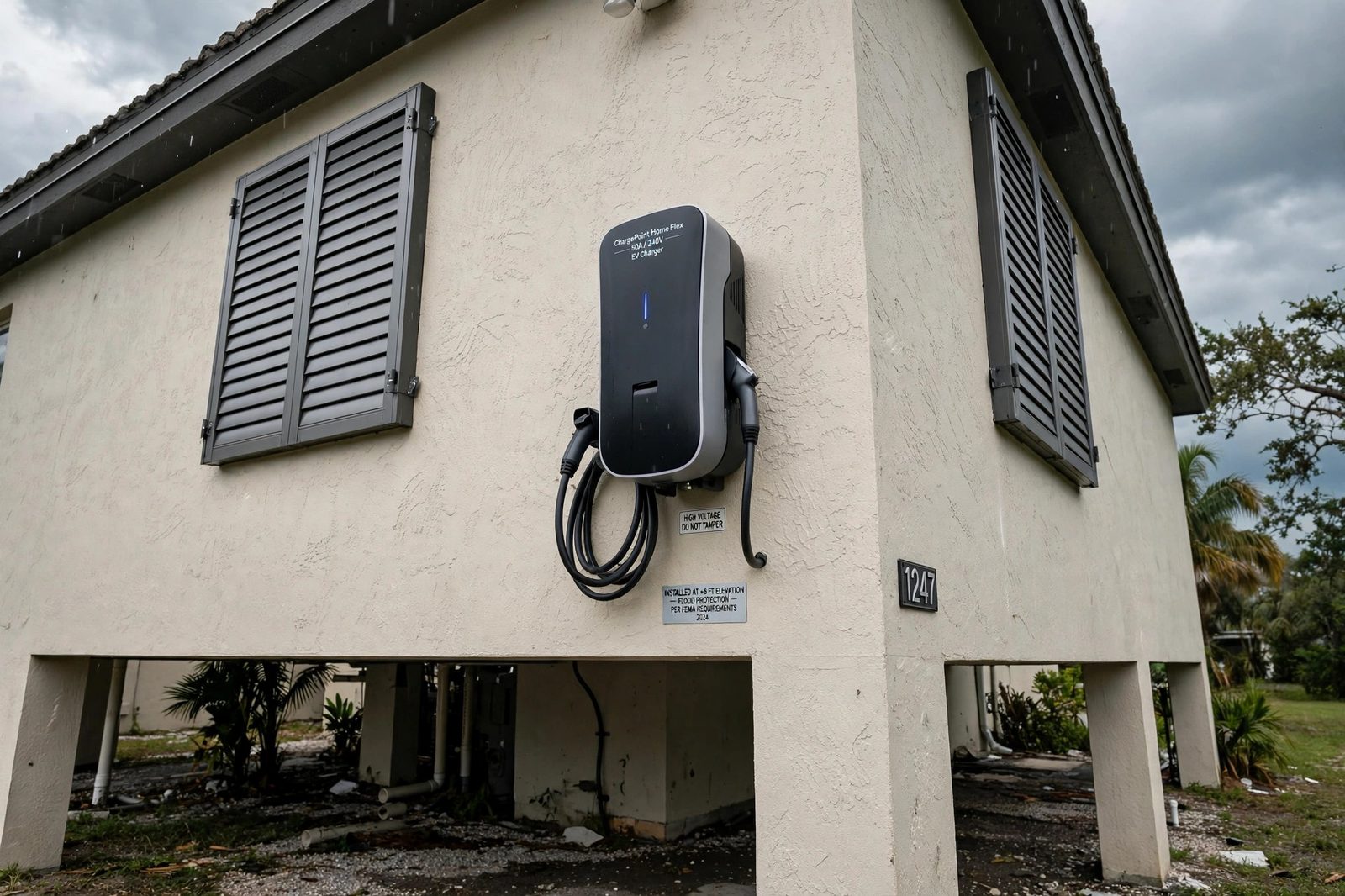
Water is the risk that ends chargers. Outdoor units should sit in a NEMA 4X weather-sealed enclosure and be mounted above the elevation floodwater plausibly reaches at your address — a particular concern for coastal and riverfront homes, where installers in places like Fort Myers, Sarasota, and Tampa routinely mount hardware high and route conduit to stay clear of ground-level water.
The one rule that matters: if floodwater reached your charger, its cable, or its outlet, do not use it and do not try to dry it out and switch it back on. Saltwater exposure is worse than freshwater because corrosion keeps working after the water is gone. A flooded charger needs inspection by a licensed electrician before reuse, and in many cases replacement — not repair — is the honest recommendation. The same applies to the car itself: never drive an EV through floodwater, and never charge or start a vehicle that sat in floodwater until it has been inspected.
During and After the Storm: Outages, Restoration, and Inspection
While the storm passes, the charger is not the priority — safety is. Do not charge during flooding, do not touch electrical equipment while wet, and do not reset a tripped charger breaker repeatedly; a breaker that trips again is telling you something is wrong.
Once power returns and stays stable, inspect before you plug in. Look for water lines on the enclosure, debris damage to conduit, discoloration or a burnt smell, and any GFCI that will not reset. Anything on that list means: leave the breaker off and call an electrician. Repairs or replacement of a 240V circuit generally require a Florida EV charger permit and inspection, just like the original install. And plan range conservatively after a storm — public chargers in the affected area may be offline too, so the first charge after restoration is worth doing before the battery runs low.
Storm-Proofing a New Install: What to Ask Your Electrician
If you are installing a charger before storm season rather than after it, the storm questions belong in the first conversation, not the last. Ask for elevated mounting above local flood levels, a NEMA 4X enclosure for any outdoor or carport location, whole-home surge protection at the panel, and conduit routed where wind-blown debris cannot easily strike it. Ask for a proper load calculation too — a charger added to an already-full 100A panel is a different job from one on a 200A service, and storm season is a bad time to discover the difference.
Pricing for that work follows the same shape as any install: a standard nearby-panel setup is the cheapest case, while long conduit runs, trenching, and panel work move the total up. Our Florida EV charger installation cost guide breaks down those variables so a storm-hardening quote is easy to sanity-check. When you are ready, Florida Home Charger connects you with licensed independent electricians in your city — call (407) 557-9563 for a free installation quote.
Common Questions
Should I unplug my EV charger during a hurricane?
Can I charge my EV during a power outage?
What if floodwater reached my charger?
Does a whole-home surge protector fully protect my EV charger?
Do I need a permit to replace a storm-damaged charger?
Ready to Maximize Your Home Charging Speed?
Speak directly with independent licensed electrical contractors serving your Florida community today.
Call (407) 557-9563